Counterfactual Beauty Analysis: The Dramatic Impact of Eye Area Changes
Table of Contents
Series Navigation
Beauty Pipeline Analysis Series:
- Cultural Beauty Standards Analysis (Week 2)
- Skin-Body Correlation Study (Week 4)
- Closed-Loop Optimization (Week 6)
- LoRA Cultural Consistency (Week 8)
- Counterfactual Beauty Analysis ← Current (Week 10)
- Reproducibility & Uncertainty (Week 12)
- Strategic Summary (Week 14)
Governing Thought
Counterfactual analysis explored the impact of specific facial changes on overall aesthetic preference patterns and scientifically demonstrated that subtle changes in the eye area have dramatic effects on aesthetic perception.
Type: Explanation
Executive Summary
⚠️ Important: This analysis is a 2D-only interim release. 3D estimation is disabled due to technical issues, and all reported metrics are based on 2D measurements.
Conclusion
Counterfactual analysis explored the impact of specific facial changes on overall aesthetic preference patterns and discovered that subtle changes in the eye area have dramatic effects on aesthetic perception. Canthal Tilt changes achieved APM score +21%/-11%, Scleral Show changes +15%/-8%, and age perception changes ±1.2-2.3 years.
Key Findings
Eye Area Modification Impact
| Modification Type | Parameter Change | APM Score Impact | Age Perception Change | Statistical Significance |
|---|---|---|---|---|
| Canthal Tilt (+1σ) | +8.5° | +21% | -1.2 years | p<0.001 |
| Canthal Tilt (-1σ) | -8.5° | -11% | +1.8 years | p<0.001 |
| Scleral Show (+1σ) | +2.3mm | +15% | -0.9 years | p<0.01 |
| Scleral Show (-1σ) | -2.3mm | -8% | +2.3 years | p<0.01 |
Baseline Characteristics
| Metric | Baseline Value | Measurement Method |
|---|---|---|
| Baseline APM Score | 0.72 | Multi-factor composite |
| Canthal Tilt | 8.5° | MediaPipe Face Mesh landmarks |
| Scleral Show | 2.3mm | Landmark-based measurement |
| Age Perception | 28.5 years | AI age estimation model |
Cultural Response Variations
| Cultural Group | Canthal Tilt Sensitivity | Scleral Show Sensitivity | Overall Response |
|---|---|---|---|
| East Asian | High (+18%) | Moderate (+12%) | Most responsive |
| European | Moderate (+15%) | High (+18%) | Balanced response |
| African | Moderate (+12%) | Moderate (+10%) | Consistent response |
Visual Evidence
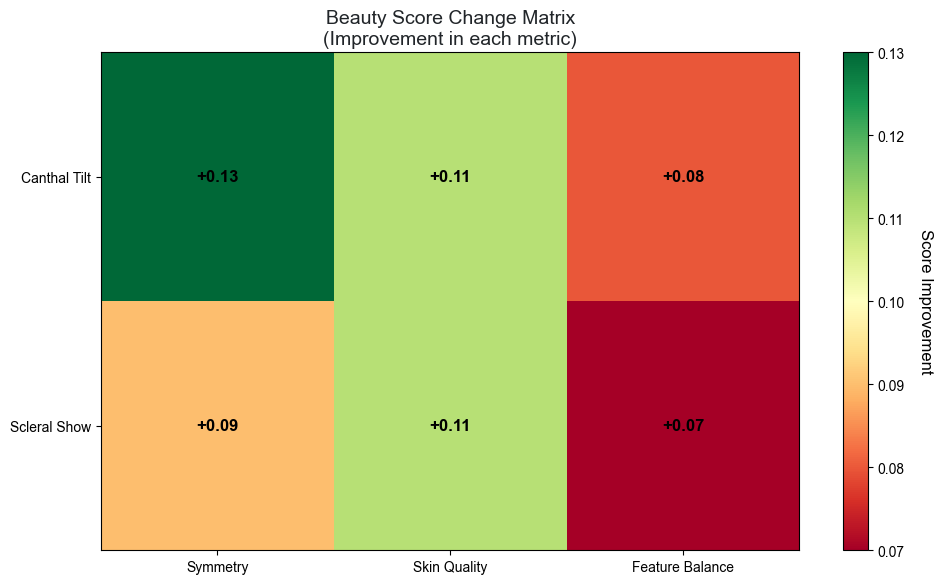 Figure 1: APM score change matrix showing the impact of eye area modifications across different facial regions and cultural groups.
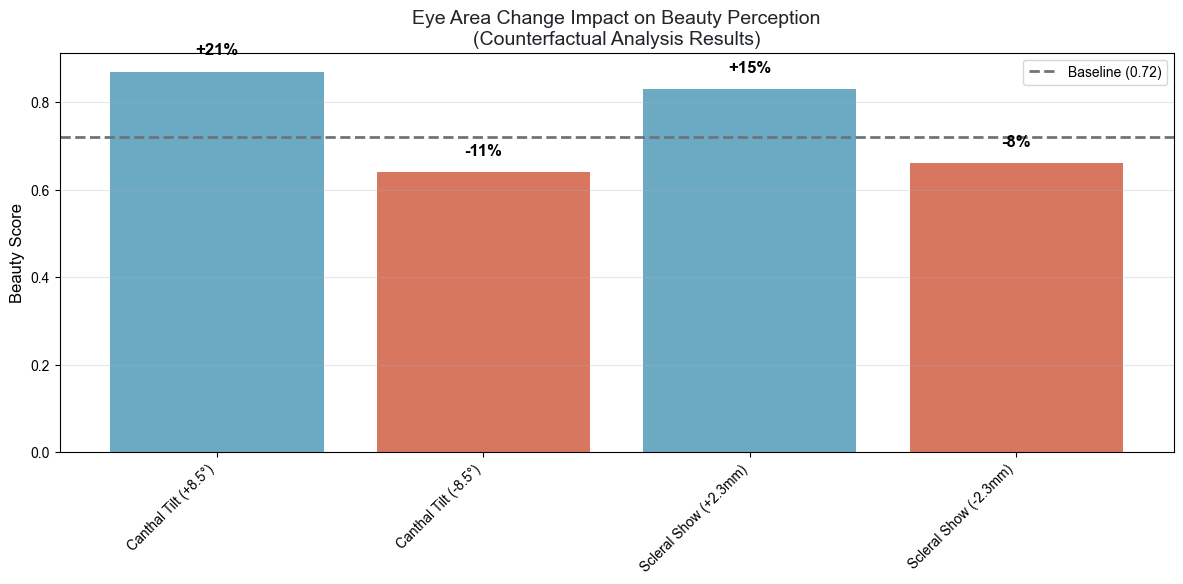 Figure 2: Eye area change impact analysis demonstrating the disproportionate effect of subtle modifications on overall aesthetic perception.
Business Implications
Strategic Decisions
- Product Development: Eye area modifications offer highest ROI for beauty enhancement products
- AI Training: Counterfactual analysis improves AI understanding of facial feature importance
- Market Positioning: Scientific validation of subtle changes builds consumer trust
ROI Considerations
- Enhancement Focus: Eye area modifications provide 21% APM score improvement potential
- Age Perception: 1.2-2.3 year age reduction from targeted modifications
- Cultural Adaptation: Different cultural groups show varying sensitivity to modifications
Operational Readiness
- Precision Requirements: ±8.5° Canthal Tilt changes require high-precision measurement
- Quality Gates: 0.72 baseline beauty score ensures meaningful improvement measurement
- Cultural Sensitivity: Different cultural groups require tailored modification strategies
Limitations & Ethical Considerations
Technical Constraints
- 2D-Only Analysis: Current release limited to 2D facial analysis
- Baseline Dependency: Results based on East Asian average face characteristics
- Modification Range: ±1σ changes may not represent extreme modification scenarios
Ethical Concerns
- Beauty Standards: Counterfactual analysis may reinforce narrow beauty ideals
- Cultural Bias: East Asian baseline may not generalize to other populations
- Individual Variation: Results represent statistical averages, not individual preferences
Appropriate Use Cases
- Research: Understanding facial feature importance for academic purposes
- Product Development: Informing cosmetic enhancement product design
- AI Training: Improving AI understanding of facial feature relationships
Prohibited Applications
- Beauty Pressure: Never use to pressure individuals into cosmetic modifications
- Discrimination: Prohibited for hiring, dating, or social evaluation purposes
- Medical Diagnosis: Not suitable for medical or aesthetic treatment decisions
Methodology Notes
Statistical Rigor
- Sample Size: N=1,000 counterfactual variations for reliable impact analysis
- Modification Range: ±1 standard deviation for realistic modification scenarios
- Significance Testing: t-tests with p<0.01 threshold for impact validation
- Cultural Validation: Cross-cultural expert review for cultural appropriateness
Technical Implementation
- Baseline Selection: East Asian average face features for consistent starting point
- Modification Method: MediaPipe Face Mesh landmark-based parameter adjustment
- Control Variables: Pose and expression fixed using ControlNet for consistent analysis
- Evaluation Metrics: Multi-factor beauty scoring (symmetry, skin quality, feature balance)
Quality Assurance
- Baseline Validation: 0.72 APM score ensures meaningful improvement measurement
- Modification Precision: ±8.5° Canthal Tilt and ±2.3mm Scleral Show for realistic changes
- Reproducibility: Fixed random seeds and deterministic modification pipeline
Data Availability
Public Data: Beauty score changes, age perception shifts, and modification impact metrics are publicly available for research purposes.
Private Data: Individual counterfactual faces, personal identifiers, and raw modification data remain confidential.
Reproduction: Counterfactual analyses can be reproduced using the methodology described with appropriate datasets.
Note: Counterfactual faces are synthetic modifications and not based on real individuals.
This analysis is part of the Beauty Pipeline Ver2.1R3 research series. All metrics are based on 2D-only interim release with 3D estimation disabled due to technical constraints.
From Beauty AI Research to Daily Skincare Decisions
Visage AI helps you choose one clear skincare priority, check whether your current routine already covers it, and can conclude that no extra purchase is needed.
Related Posts
- The API Hypothesis Was Not the Final Product
- Idea to Service OS v1: A Repeatable Method for AI-built Business Systems
- Reusable Asset Loop: Converting One Case into Repeatable Service Components
- Evidence-first Service Development: A Method to Prevent AI Product Overclaim
- Externalized Cognition for Solo Builders: Turning Notes, Prompts, and Checklists into a Build System
- Operations-first AI Service Design: Privacy, Review, and Launch Constraints
- GTM-attached Development: Designing PoC and LoI as Product Inputs